Keep in Touch Series

The
Antenna and VSWR
Keep in Touch Series |
|
|
|
|
|
|
|
|
|
|
|
The
Antenna and VSWR |
|
 |
In days of old, when knights were bold And radio was not invented They sent their thoughts on lumps of quartz And their envelopes were cemented. |
You probably have
a good idea on how a radio signal gets from a transmitter (TX) to a receiver
(RX), but have you ever thought about the role that the antenna plays? VSWR (Voltage Standing Wave Ratio) is what
it’s all about. Without the correct
VSWR, your TX is worthless. First, let’s consider what happens between a
transmitter and a receiver. In
the early days, it was discovered that a coil of wire with a voltmeter attached
to it registers a voltage across the coils whenever a spark occurred near
it. In fact, the spark transmitter, as it became
to be know, became a workbench for ongoing experiments that led the great
inventors like Faraday, Hertz and Marconi to the wireless technologies that
we have today. Essentially, a radio transmission occurs when electrical
energy get imparted in to the air and it becomes electro-magnetic.
To do this the electrical signal has to be constantly changing in
voltage and current flow. A spark,
of course, is a good example of an electrical current in violent and instant
change. These days, transmissions induced by sparks
are often noticed as annoying interference, like the spark of a spark-plug
in our automobiles. A modern radio
transmission signal is developed as an electrical current that constantly
alters from its maximum voltage in one direction (positive) to its maximum
voltage in the other direction (negative).
A bit like constantly reversing the battery connections to a motor. The voltage is changed smoothly in what is
known as a sine wave. 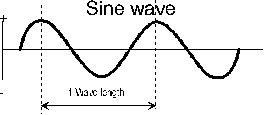 This type of Alternating
Current is known as AC.
The household current is AC and it alternates positive to negative
and back to positive 60 time per second (60 Hertz, 60 Hz) So, does household
current transmit? Yes it does. But because it is such a low frequency (60
Hz) it doesn’t do it very well. It
doesn’t do it well also because it always drives a load (a TV, a vacuum
cleaner) that absorbs all of the available energy. A radio signal is usually
a much higher frequency (In R/C it’s around 72,000,000 Hz, 72 Mhz -- Mhz
is pronounced “Megahertz”). The radio signal is sent to an antenna
rather than to an appliance such as a TV. So how does an antenna work. That’s
the subject of this article. This type of Alternating
Current is known as AC.
The household current is AC and it alternates positive to negative
and back to positive 60 time per second (60 Hertz, 60 Hz) So, does household
current transmit? Yes it does. But because it is such a low frequency (60
Hz) it doesn’t do it very well. It
doesn’t do it well also because it always drives a load (a TV, a vacuum
cleaner) that absorbs all of the available energy. A radio signal is usually
a much higher frequency (In R/C it’s around 72,000,000 Hz, 72 Mhz -- Mhz
is pronounced “Megahertz”). The radio signal is sent to an antenna
rather than to an appliance such as a TV. So how does an antenna work. That’s
the subject of this article. 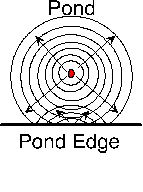 If did your homework assignment
described in Part 3, you may have noticed that the ripples in a pond radiate
from the point where the stone fell into the water. An alternating current also does this. When the voltage is high going into a wire, that high voltage does
not instantly get to the other end, rather it travels down the wire at a
finite speed at approximately 2/3 to 3/4 the speed of light (for copper
wire). That means that by the time
that high voltage gets to some point along the wire, the voltage at the
end has altered (remember an AC voltage is constantly changing) and is now
a different voltage. So, if you
could take a voltage snapshot of the length of wire with an AC current in
it you would see different voltages all along the length of the wire in
a sine wave picture. There are instruments
that allow you to tap into a wire and move it along to actually read the
different voltages. If did your homework assignment
described in Part 3, you may have noticed that the ripples in a pond radiate
from the point where the stone fell into the water. An alternating current also does this. When the voltage is high going into a wire, that high voltage does
not instantly get to the other end, rather it travels down the wire at a
finite speed at approximately 2/3 to 3/4 the speed of light (for copper
wire). That means that by the time
that high voltage gets to some point along the wire, the voltage at the
end has altered (remember an AC voltage is constantly changing) and is now
a different voltage. So, if you
could take a voltage snapshot of the length of wire with an AC current in
it you would see different voltages all along the length of the wire in
a sine wave picture. There are instruments
that allow you to tap into a wire and move it along to actually read the
different voltages. 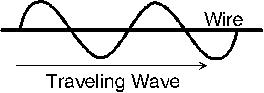 If you can picture this easily,
you will see in your minds eye, that if you take another snapshot an fraction
of a second later, the sine wave will still be there, but it will have moved
down the wire. This is what is called
a “Traveling wave”. It is almost
exactly the same as the ripples in the pond.
The wave always looks the same, but the crests and troughs constantly
travel outwards towards the pond’s edge. The traveling wave in a wire assumes
that the wire, for all intents and purposes, is infinite in length, or it
is terminated in an absorbing load. If
we were to consider the wire to be connected to an antenna, then we would
see that it is not infinite in length.
The ripples in the pond assume the pond is an infinite size - they
know nothing about the pond’s edge until they reach it. For an antenna to
work efficiently, it must be of a length close to an even multiple of a
quarter wave length. Going back
to the ripples on the pond. The
waves had crests and troughs, obviously.
How far apart were the crests on your ripples?
6 inches, maybe. Well, what
ever it was that is the wave length. It’s
the same with a traveling wave in a wire.
If you divide that length into quarters, that is a quarter wave length. An antenna, therefore, should be 1/4, 1/2 of
a full wave length long to be efficient. If you can picture this easily,
you will see in your minds eye, that if you take another snapshot an fraction
of a second later, the sine wave will still be there, but it will have moved
down the wire. This is what is called
a “Traveling wave”. It is almost
exactly the same as the ripples in the pond.
The wave always looks the same, but the crests and troughs constantly
travel outwards towards the pond’s edge. The traveling wave in a wire assumes
that the wire, for all intents and purposes, is infinite in length, or it
is terminated in an absorbing load. If
we were to consider the wire to be connected to an antenna, then we would
see that it is not infinite in length.
The ripples in the pond assume the pond is an infinite size - they
know nothing about the pond’s edge until they reach it. For an antenna to
work efficiently, it must be of a length close to an even multiple of a
quarter wave length. Going back
to the ripples on the pond. The
waves had crests and troughs, obviously.
How far apart were the crests on your ripples?
6 inches, maybe. Well, what
ever it was that is the wave length. It’s
the same with a traveling wave in a wire.
If you divide that length into quarters, that is a quarter wave length. An antenna, therefore, should be 1/4, 1/2 of
a full wave length long to be efficient. 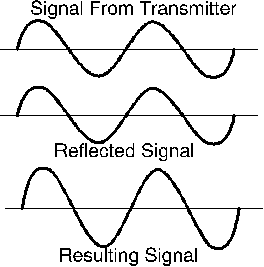 Going back to the ripples,
let’s consider what happened when one of the ripples reached the pond edge. Since they could go no further, but it still
contains an amount of energy, the ripple seems to “Bounce” off the edge
and it gets reflected back into the path of new ripples coming out from
the center of the pond. The new
ripples and the older reflected ripples collide;
their crests and troughs mix. When
a new crest and an old reflected crest mix, the resulting crest can actually
become larger than either of them. When a crest meets a trough, they cancel each other and the wave actually decreases. Going back to the ripples,
let’s consider what happened when one of the ripples reached the pond edge. Since they could go no further, but it still
contains an amount of energy, the ripple seems to “Bounce” off the edge
and it gets reflected back into the path of new ripples coming out from
the center of the pond. The new
ripples and the older reflected ripples collide;
their crests and troughs mix. When
a new crest and an old reflected crest mix, the resulting crest can actually
become larger than either of them. When a crest meets a trough, they cancel each other and the wave actually decreases.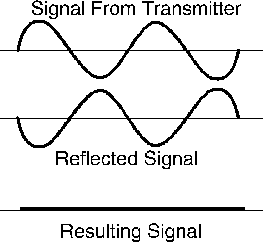 Well, since an antenna is
not connected to an absorbing load, it acts like the edge of a pool. Just
like the ripples in your pond, the water traveling wave has nowhere to go.
When the electrical traveling wave reaches the end of the antenna, it, also,
has nowhere to go. So it does the
same as those ripples; it reflects back down the antenna wire towards the
TX. The reflecting waves colliding with the new
waves coming along from the TX. Because this is a dynamic environment, it’s
always changing, I’m going to ask you to use your mind’s eye, again.
Imagine, if you will, if you could move the tip of the antenna with
respect to its base (make it longer and shorter).
That would affect the timing of the reflected signal vis-à-vis the
signals from the TX. Well, since an antenna is
not connected to an absorbing load, it acts like the edge of a pool. Just
like the ripples in your pond, the water traveling wave has nowhere to go.
When the electrical traveling wave reaches the end of the antenna, it, also,
has nowhere to go. So it does the
same as those ripples; it reflects back down the antenna wire towards the
TX. The reflecting waves colliding with the new
waves coming along from the TX. Because this is a dynamic environment, it’s
always changing, I’m going to ask you to use your mind’s eye, again.
Imagine, if you will, if you could move the tip of the antenna with
respect to its base (make it longer and shorter).
That would affect the timing of the reflected signal vis-à-vis the
signals from the TX. 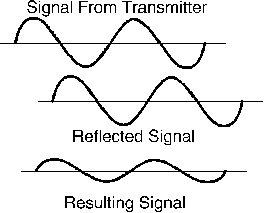 If you adjust it so that it was in perfect
synchronization with the new wave coming from the TX, the reflected wave
crests and the new crests would collide at exactly the same spot on the
antenna. This would cause the traveling
wave to stop (or to appear to do so). To
become stationery. To become a “Standing
wave”. If we were to use that device
that measure crests and trough (I mentioned it earlier), and move it along
the length of the antenna, we would see the crests of energy always at the
same place. The synchronization of the new signal and the reflected signal
will occur when the length of the antenna is 1/4 wave length. Assume a 72
Mhz signal traveling in an antenna at 2/3 speed of light (200meters per
microsecond). This will have a wavelength of 120 - inches. Therefore,
a 1/4 wavelength is 30 inches. (Is the antenna on your TX about 30 inches? If so, this is why). Some internal electrical circuits used in modern
transmitters can alter the apparent speed of the signal, thus changing the
required antenna length. Although there are many other factors that affect
this, we will consider only antenna length.
If the antenna length changes from 1/4 wave length, the amount of
non-synchronized reflected waves increases, causing the “Standing Wave”
to move. This error can be measured
as a percentage of the transmitter signal. A perfect reflection is in exact
synchronization and is therefore equal to the transmitted signal. The ratio of these signals is therefore 1:1
(referred to as a ratio of 1). As the reflected wave becomes less synchronized,
the two signals become less equal and the ratio, therefore, changes.
this ratio is called the Voltage Standing Wave Ratio, VSWR.
A VSWR of 1 is perfect. A
VSWR of 1.2 is pretty good. A VSWR
of 1.5 is very marginal. A VSWR
of greater than 1.5 is usually unacceptable.
Now you’ll make sure your TX antenna is fully extended before you fly, won’t
you?? Just one more point, you’ve probably seen those short flexible antennas
that are nowhere close to 30 inches in length.
The way they do this is to place a coils of wire at the base of the
antenna. This “Fools” the signal from the TX into thinking the antenna is
longer than it really is. This,
of course, is a very simplistic description.
There are many very good books available if you want a more detailed
explanation. This concludes my four part series on R/C radio theory. The detailed technology is much more complex
than I have indicated in these articles.
I deliberately kept the explanations as simple as I could to illustrate
the general concept of how an R/C radio system works. Fly high and enjoy. If you adjust it so that it was in perfect
synchronization with the new wave coming from the TX, the reflected wave
crests and the new crests would collide at exactly the same spot on the
antenna. This would cause the traveling
wave to stop (or to appear to do so). To
become stationery. To become a “Standing
wave”. If we were to use that device
that measure crests and trough (I mentioned it earlier), and move it along
the length of the antenna, we would see the crests of energy always at the
same place. The synchronization of the new signal and the reflected signal
will occur when the length of the antenna is 1/4 wave length. Assume a 72
Mhz signal traveling in an antenna at 2/3 speed of light (200meters per
microsecond). This will have a wavelength of 120 - inches. Therefore,
a 1/4 wavelength is 30 inches. (Is the antenna on your TX about 30 inches? If so, this is why). Some internal electrical circuits used in modern
transmitters can alter the apparent speed of the signal, thus changing the
required antenna length. Although there are many other factors that affect
this, we will consider only antenna length.
If the antenna length changes from 1/4 wave length, the amount of
non-synchronized reflected waves increases, causing the “Standing Wave”
to move. This error can be measured
as a percentage of the transmitter signal. A perfect reflection is in exact
synchronization and is therefore equal to the transmitted signal. The ratio of these signals is therefore 1:1
(referred to as a ratio of 1). As the reflected wave becomes less synchronized,
the two signals become less equal and the ratio, therefore, changes.
this ratio is called the Voltage Standing Wave Ratio, VSWR.
A VSWR of 1 is perfect. A
VSWR of 1.2 is pretty good. A VSWR
of 1.5 is very marginal. A VSWR
of greater than 1.5 is usually unacceptable.
Now you’ll make sure your TX antenna is fully extended before you fly, won’t
you?? Just one more point, you’ve probably seen those short flexible antennas
that are nowhere close to 30 inches in length.
The way they do this is to place a coils of wire at the base of the
antenna. This “Fools” the signal from the TX into thinking the antenna is
longer than it really is. This,
of course, is a very simplistic description.
There are many very good books available if you want a more detailed
explanation. This concludes my four part series on R/C radio theory. The detailed technology is much more complex
than I have indicated in these articles.
I deliberately kept the explanations as simple as I could to illustrate
the general concept of how an R/C radio system works. Fly high and enjoy.
|
|