Keep in Touch Series

PPM
vs. PCM
Glossary:
PPM -- Pulse Position Modulation
PCM -- Pulse Code Modulation
In the last section we discussed the AM and FM technologies. In this third
part of the R/C System discussion we will look at the difference approaches
that are employed to actually tell each servo what to do.
  |
To “pulse” something means to cause something to happen for a relatively short time then to stop. The turn indicators on your car pulses. Your heart pulses.In an R/C system, the transmitter is pulsed too.
In an AM (Amplitude Modulation) TX (See Part 2), the amplitude, or TX power, is pulsed from low power to high power. In an FM (Frequency Modulation) TX, the frequency of the TX is pulsed away from nominal momentarily.By the way, there are several answers to the homework assignment in Part 2. But probably the most obvious is that you may have chosen to learn the Morse Code. The Morse Code describes a unique series of long and short pulses for each letter and symbol in the alphabet. By pulsing the signal light on and off for the right amount of time and in the right sequence, one person can correspond with another by pulsing their light.So, in the Morse code, we must be able to differentiate between long and short pulses. This leads us to a couple more questions. One, how does that control the position of a servo, and two, how can we operate multiple control channels on the same system. We’ll address question one first.
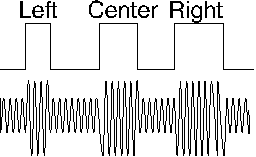
The servo electronics is designed so that it receives a pulse of electric current from the receiver that corresponds to the pulse transmitted by the TX. It is also configured so that the position of the servo motor will correspond to the length of that pulse. For example, if the pulse were to be short, say, 1mSec (one thousandth of a second) the servo motor will move to its most extreme counterclockwise position and stay there. If the pulse were to be long, say 2 mSecs, the servo motor will go to its extreme clockwise position and stay there. For pulse width between 1 and 2 mSecs, the servo motor will go to and stay at a proportionally corresponding position. This system is technically called “Pulse Width Modulation” (PWM). In R/C we are more apt to call it “Pulse Position Modulation” (PPM).
To create pulses of differing width, the transmitter uses a circuit called a encoder that modulates the TX with a pulse width corresponding to position of the TX control stick.
 |
So there you have it. Pulse Position Modulation (PPM) at work.
Before we take a look at PCM, let’s first discuss the second question -- How can we control multiple channels from one TX?
First, don’t get confused by the term “Channels” When we are talking about transmitter frequencies, channel refers to the actual frequency. There are 50 channels (Channel 11 to 60) and each channel is a different radio frequency. When we talk about controls and servos, etc. the word channel means the actual number of individual control outputs from the receiver. The most common radio system in R/C aviation is a 4 channel system (Rudder, Elevator, Ailerons, Throttle). If you want to use retractable wheels, bomb drop, flaps etc., you will need to use a radio that has more than 4 channels.
I will assume a 4 channel radio for the purposes of this discussion. The PPM discussed above really looked at only a single channel (We used the rudder as the control of choice). So, in a 4 channel system we need some extra stuff.
As mentioned before, the TX transmits about a hundred pulses per second. It varies between manufactures, but for discussion purposes we’ll say the TX transmits a pulse every 16 mSecs (actually, that’s about 80 pulses per second). In a 4 channel system we will identify this train of pulses in a repeating sequence of 5 pulses. We’ll call them pulses 1 through 5.
 |
That is the PPM multi-channel R/C system in a nutshell. Now for PCM.
Although Futaba calls their PPM system “Digital Proportional” in the ‘Conquest’ 4 channel system, it truly isn’t digital. Let me explain.
The term “Digital” refers to the simplest form of recognition. In any digital system, there are two conditions used - usually referred to as “ON” and “OFF”, or “Zero” and “One” A pulse system that does not rely on the shape or duration/length of the pulse - just whether it’s there or not, is digital. In the PPM system described above, pulses were used to control the position of a servo, but not by their presence; rather by measuring their pulse width.
In a true digital system pulses are still used, but they are all the same width. The message is sent by whether or not a pulse is present. But let’s give Futaba’s marketing department some poetic license. The direction indicators on your car is a digital system. The information as to whether the car in front of you will turn or not is indicated by whether or not you see the light pulsing.
Digital and Binary Counting
To use digital pulses to convey more information, we can set up a system where pulses are still sent, but different information is indicated by varying the quantity of pulses sent; -- Digital counting. More commonly known as “Binary counting”.
Decimal System
How do you count? (Can you count?). If you are like most people on this planet, you use the decimal system. That means you are limited to ten different counting symbols, namely, zero through nine (0 -- 9). That’s it, there are no others to use. So, to count beyond nine, we must be creative. Here’s how. First, count from 0 to 9. now what? Well the rule says go back to zero and increment the number to the left by one. This makes 10 (ten). Now count as normal by taking the zero up to nine again to get 19. Now apply the rule. The 9 goes back to zero and we increment the number to the left by one to get 20. Simple, right? When we get to 99, we apply the same rule. The right hand nine does to zero and we increment the next number. But in this case that, too, is a nine. So it goes to zero as well and we increment the next number to get 100. Notice, in this counting system we assume an infinite number of zeros to the left exist, we just don’t show them.
000, 001...>...009, 010, 011...>...019, 020...>...029, 100, 101...>...199, 200
Binary System
The Binary system is the same, but simpler. If “Decimal” means ten different symbols you might guess that “Binary” means two. If so, you’d be correct. But the rules are the same. Since there are only two symbols, zero and one, we can only count from zero to one before running out of symbols. If you apply the same rule as for decimal you get the Binary counting system below.
Decimal Binary
0 0
1 1
2 10
3 11
4 100
5 101
6 110
7 111
Notice that I can determine 8 real values (0 - 7) using only 3 binary symbols. Each binary symbol is called a “Bit”. If I could use 4 bits, I could determine 16 values, with 5 bits - 32 values, 6 bits -- 64 values. With 8 bits I can get 256 different values. If the diagram above looks a bit like Morse code, with the 1’s long pulses and the 0’s short one’s, that’s OK. In a digital signal, the 0’s are not short pulses; they are the absence of a pulse.
So, if you knew the timing of when “bits” were due, and I sent you a message with a flashing light that showed one pulse, then no pulse, then one pulse (1 0 1); using the diagram above you will see that I have just sent you the number “5”
If an R/C PCM system were to use eight in place of the single pulse we saw in the PPM example. So, instead of the servo measuring the length of the pulse to determine its position, it receives an 8 bit code and decodes it to get a number that ranges from 0 to 255 (256 values). It moves to a position that corresponds to this number (0 equals full left, and 256 equals full right).
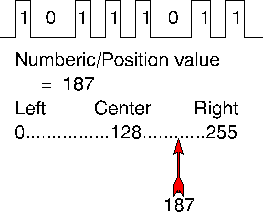 |
While the TX stick is held in the same position, this code will be constantly repeated, thus holding the servo in that position.
The next discussion talks about why PCM is preferred over PPM.
The PPM system is really an analog system. That means that we can vary the width of the control pulse to an infinite number of values. The servo will respond by positioning itself to one of an infinite number of positions. In most PCM systems, each control is represented by up to a 10 bit code that can define 1024 discrete positions. That is usually enough even for the most discerning pilot. The idea that PCM is better is because even although the number of positions is limited, each position is definite and totally accurate. In other words, PCM is more precise than PPM. Also, radio interference can cause the apparent pulse width to change giving rise to fluttering servos in a PPM system. Since the pulse width in PCM is not the controlling factor, such radio interference is eliminated. Please note. A PCM system does not eliminate radio frequency channel duplication interference.
For example, two PCM radios CAN NOT be operated on the same radio channel simultaneously. Both planes will crash if you try.
Your homework assignment!
 |
So, go to your favorite pond, preferably one that has relatively vertical edges at the water line.
Now throw in a stone and watch the ripples. In particular, watch what the ripples do when and after they hit the pond edges

Tune in again soon to find all about The Antenna and VSWR