Keep in Touch Series
The
Superheterodyne
Did your ever wonder why, or how, modern radio systems work? Specially
when you think that just a few years' ago there were only a handful of
channels, and now there are so many more? And they're much "closer" together.
As you probably know, radios work by having a transmitter create an electro-magnetic
signal that alternates from a positive direction to a negative direct
many million times per second. A bit like reversing the direction/polarity
of a battery -- first one way, then the other -- but faster. Of course,
in a transmitter, the alternations are smooth progressive changes from
one polarity to the other. The "Frequency" of that alternation, for aircraft
radios, is in the ballpark of 72,000,000 times per second (Usually referred
to as 72 mega hertz).
If we could make a receiver that receives/responds to a signal of only
one frequency we could arrange for various transmitters on slightly different
frequencies with receivers that respond only to one particular transmitter.
Well, this is exactly what happens. Each slightly different frequency
is called a "Channel"
The greater the number of channels that are required within a specific
frequency range requires that the "Channels" are closer together; the
frequency difference between channels gets smaller. The two main tricks
are to get a transmitter that accurately transmits on a specific frequency
("Channel") and for it not to drift away from that frequency, and, to
make a receiver respond to that frequency and no others. That's where
modern day Superheteradyne receivers come in.
Let's draw another comparison. I think we all understand that any machine,
such as a reciprocating engine, works better at one particular RPM. The
RPM is actually the "Frequency" of the machine. Think about why we have
tuned pipes or how/why a constant speed prop. works. Keep this thought.
Since a receiver is manufactured to respond to any frequency (that it
is tuned to) in the 72 megahertz range, its "Front end" must accommodate
all valid frequencies (Channel 11 to 60). However, as we discussed, any
machine is more efficient if its frequency is constant. Therefore, if
an electronic circuit is designed to respond to a fixed frequency, it's
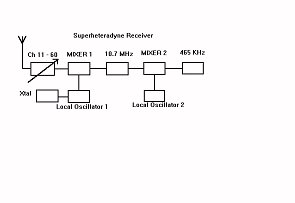
efficiency is much improved. In a Superheteradyne, the incoming signal
(which can be any frequency from channel 11 to channel 60) from the transmitter
is electronically mixed (in a Mixer) with a signal generated within the
receiver (Local Oscillator). The tuning crystal we install into receiver
actually creates this internal signal. It is arranged that the difference
between the transmitter frequency and the local oscillator is always the
same regardless of the channel tuned to. When you electrically mixes two
different frequencies, the result is a new signal at a frequency equal
to the difference. Therefore, the output from the mixer is ALWAYS the
same frequency (Intermediate frequency). The following electronics (Intermediate
Frequency, IF, amplifier). Because the IF is ALWAYS constant frequency,
the IF amplifier can be very selective to that frequency. This is what
allows the very sharp, specific and selective accuracy that we expect
from our RC equipment. This intermediate frequency is 10.7 megahertz (10,700,000
cycles per second).
This is still a very high frequency. Even the best accuracy in this range
is not good enough for the selectivity we require in a modern RC radio
system. To get the closeness of frequencies that we now enjoy, we must
have an intermediate frequency much lower than 10.7 MHz.
What happens now is the 10.7 MHz is applied to yet another mixer. There
is also another local oscillator. The result is a much lower frequency
IF -- 465 KHz (465,000 cycles per second). Such a frequency can be tuned
and made selective to within 20 Khz, which is today's accepted channel
separation. These dual mixer and dual intermediate frequency superheteradyne
receivers are usually referred to as "Dual Conversion" receivers.
As a side issue. When two transmitters are operating that are 23 channels
apart, the two signals "Mix" in the air. Since each channel is separated
by 20 KHz, the resulting frequency is 23 times 20 KHz which equals 460
KHz. This is real close to the Dual Converted second intermediate frequency
of 465 KHz. This can interfere with any third and subsequent receivers
that are switched on at the same time. That's why, channel 42 and 19,
for example, shouldn't fly together....
Remember, none of this matters if you haven't charged your batteries.
Tune in again soon to find out the difference between AM and FM
